
Sync your setup between machines through your own private repo
Your workspaces and scenarios follow you to the next machine, through a repository nobody else owns.
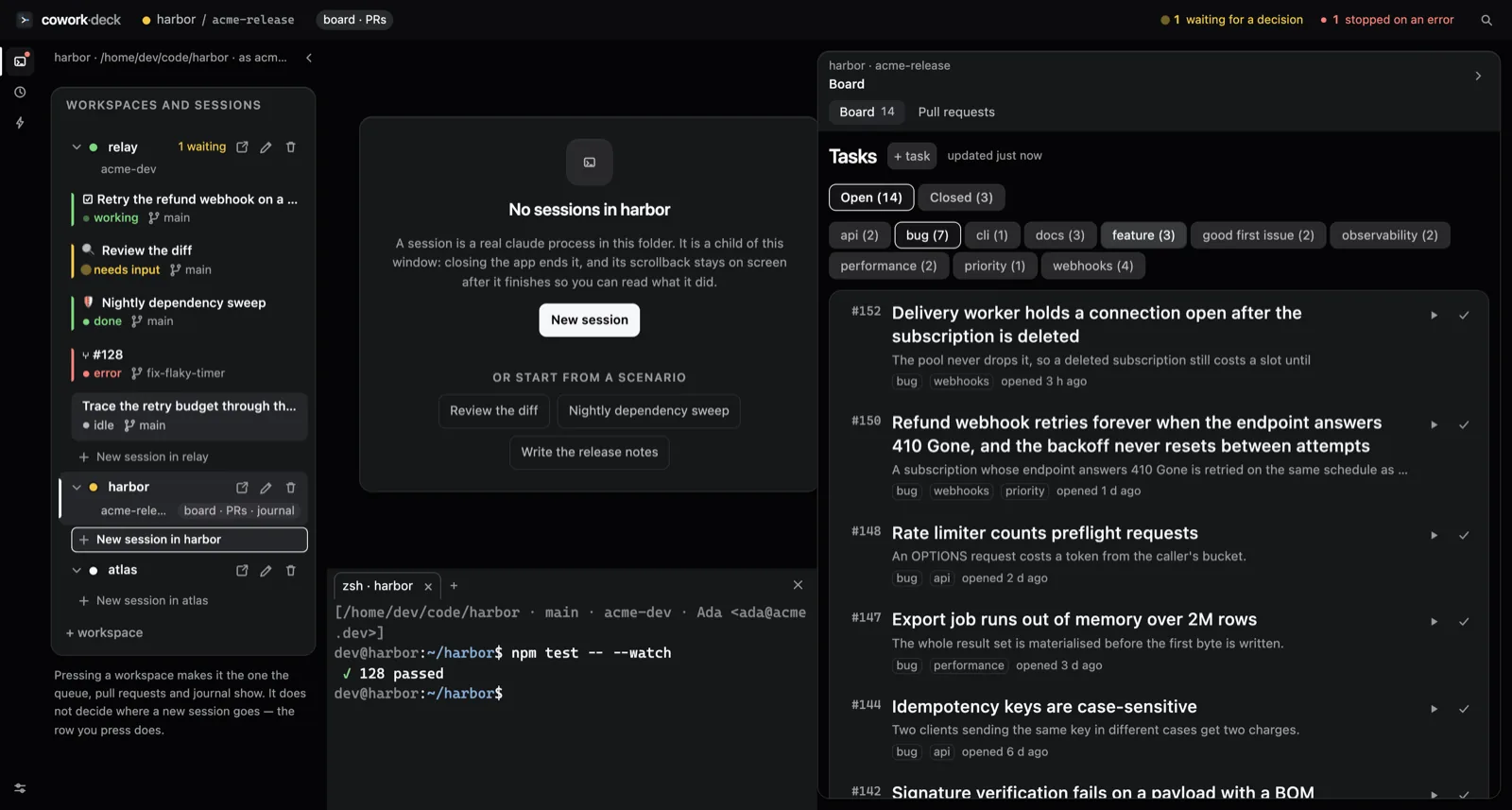
A private repository, not a service
Your workspaces, their GitHub bindings, your scenarios and the journal of what has run can live in a private GitHub repository you own. A second machine then has them without anybody copying files by hand.
There is no account to create here, no server that holds your data, and no telemetry. The config directory is the repository — a decision recorded in ADR-0006 rather than left implicit.
It is off until you switch it on, from Memory sync… in the
command palette. Switching it on needs gh and a connected
account, and offers both halves of the job: create a private repository, or
connect the one you already have — which is what every machine after the
first does.
What travels
- Workspaces and their GitHub bindings.
- Scenarios, with their placeholders and defaults.
- The run journal — one file per machine, so two never collide.
- The memory corpus behind project memory, so an agent on the second machine can search what sessions on the first one decided.
What does not
Session layout, window state, and terminal drawers stay local. The repository is an allowlist, not a filter — and a test asserts the tracked set equals it exactly, so a new setting cannot start travelling by accident.
Absolute paths never travel. A workspace arriving from another machine has no folder here until you point it at one. And a schedule arrives switched off, so a 03:00 job does not quietly start firing on two machines at once.
Conflicts are not resolved for you
If two machines change the same thing, you are told. Notes are prose, and an automatic merge of prose produces a plausible paragraph that nobody wrote — which is worse than a conflict, because it looks finished.
Project memory, and where it is
The corpus that travels is the one behind project memory — semantic search over what earlier sessions actually did and decided, for you and for agents through an MCP tool of their own. The embedding model runs on your machine, so the index never leaves it, and what moves between machines moves through a repository you own rather than through anybody's cloud.